On the second day of the Lunar New Year, before dawn, car horns sounded at the village entrance – it was the horn of “Son in Law Festival”. My wife was “borrowed” by her family for a whole day. This scene is played out every year, but few people ask: Why is it “back”? Whose home did you return to? The answer is hidden in the Six Rites three thousand years ago, as well as in the original design of the word “daughter-in-law”.On the second day of the Lunar New Year, before dawn, car horns sounded at the village entrance – it was the horn of “Son in Law Festival”. My wife was “borrowed” by her family for a whole day. This scene is played out every year, but few people ask: Why is it “back”? Whose home did you return to? The answer is hidden in the Six Rites three thousand years ago, as well as in the original design of the word “daughter-in-law”.
Liuli: A Relay Race That Treats Women as “Tokens”
Zhou people divided marriage into six steps, each step reinforcing the “patrilineal firewall”:
- Nacai . – The man sends geese, but the geese do not return to the nest, implying that “the water splashed out by the daughter who has married off”.
- Asking for Name . – Changing the Geng Time is essentially checking household registration to prevent the same surname from “contaminating” the patrilineal bloodline.
- Najib . – Ancestral temple divination, writing personal marriages as family “betting agreements”.
- Collection . – A dowry is presented, consisting of a bundle of silk and two ingots of silver, to purchase a woman’s reproductive rights for the rest of her life.
- Request . – Choosing auspicious days on the yellow road is a way to “set an example” for both clans, ensuring that the ceremony does not conflict with the farming season and sacrificial offerings.
- Welcoming .- The groom personally receives and completes the delivery of the “person”. From then on, the female leaves the patrilineal ancestral temple and belongs to the husband’s ancestral hall (“The Book of Rites: Faint Righteousness”).
The entire process is like a cross term contract: Party A (father) hands over, Party B (husband) promises incense. A woman has become a walking “real estate”, but her name is not on the property ownership certificate.
Gifts: Seemingly “Buying and Selling”, but Actually “Risk Hedging”
Modern people consider dowries as a bad habit, but Song Dynasty law regards them as a “mirror image of dowry”. The Book of Minggong’s Judgment on Qingming “records:” The wealth obtained from employment is the same as the wedding capital, and if one regrets the marriage, it will be returned twice (“Liu Liyan, 2003). In other words, the dowry is a “guarantee deposit” placed by the man, which can offset the woman’s “remarriage loss” in the event of her husband’s premature death or divorce.Modern people consider dowries as a bad habit, but Song Dynasty law regards them as a “mirror image of dowry”. The Book of Minggong’s Judgment on Qingming “records:” The wealth obtained from employment is the same as the wedding capital, and if one regrets the marriage, it will be returned twice (“Liu Liyan, 2003). In other words, the dowry is a “guarantee deposit” placed by the man, which can offset the woman’s “remarriage loss” in the event of her husband’s premature death or divorce.
A “Private Appropriation” Permit Given to Daughters by Patriarchal Society
The opposite of the dowry is the heavy camphor box. Since the Song Dynasty, the laws of all dynasties have been clearly written as follows:
- The dowry is the wife’s “exclusive property” and cannot be divided among the husband’s family;
- If the couple divorces, the dowry list will be returned in its original state;
- If a wife is widowed, her dowry can support her for life, and even pass it on to her biological children, and she will never adopt a stepson in the family (“Song Dynasty Criminal Code: Household Marriage Law”).
One sentence: Father bought his daughter a dowry with the confidence to say no. Seemingly inverted, it is the only crack left within patriarchy – allowing women to have an economic escape route after “getting married”.
Sitting in a Sedan Chair: A Performance Surrounded by Onlookers
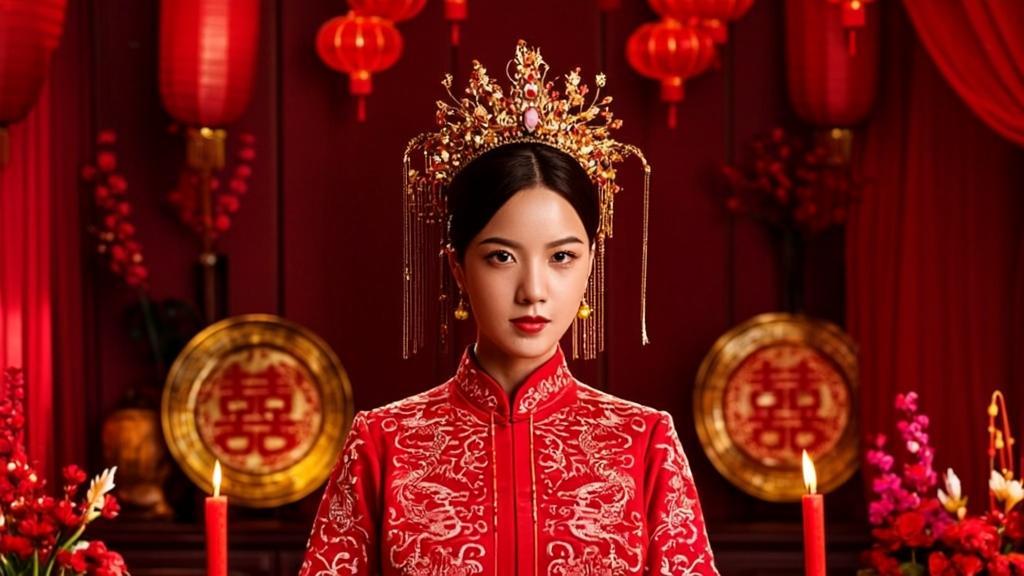
Starting from the Southern Song Dynasty, flower sedan chairs replaced hiking, with embroidered “Danfeng Chaoyang” on the top of the sedan chairs and “Baizi Tu” hanging on the curtains. On the surface, it appears festive, but in reality, it temporarily elevates women to an “untouchable” altar:
- The sedan chair bearers shouted “avoid evil”, while passersby scattered rice, which was “yang”, shielding her from “yin” qi;
- Crossing the brazier and stepping on tiles, symbolizing “burning” the traces of the ancestors of the maternal family and “stepping” on the original social personality of women;
- Once the sedan curtain is lifted, she has to “register her ID card” again in her husband’s ancestral hall.
The sedan chair is a moving stage, the audience is the entire street, but the script only takes effect in the ancestral temple genealogy.
Marriage Recruitment: The Reverse Operation of “Entering into the Family” Script
If there is a marriage, there is a “backdoor”. In the Huizhou documents of the Ming and Qing dynasties, 17% of the marriage contracts stated that “the man is born into a family” – the husband moved into his wife’s house, changed into a woman’s ethnic costume, and gave birth to a child with the mother’s surname. In order to prevent the phenomenon of “son-in-law taking over as the main guest”, the folk invented the triple lock:
- Change of family name without change of registration .- The husband’s registered residence remains the original, and the memorial tablet will be returned after death;
- Write a “Half Son Contract” . – the document states “only half of the inheritance, no sacrificial sovereignty”;
- Pre marital “Crossing the Door” Ceremony – The husband first “bids farewell to his ancestors” at his ancestral temple, and then “worships the new mountain” at his wife’s house, symbolizing the “death” of his original identity.
Marriage is like a six ritual of gender inversion, temporarily feminizing men, but using more detailed provisions to remind them that the rules are still patrilineal, but this time it is the male who is “transferred”.
Conclusion
On the second day of the Lunar New Year, the wife is washing dishes at her maternal home – temporarily taking the woman out of the husband’s sight and providing a “renewal” buffer for the patriarchal society.
In other words, back door is not romantic, but an automatic update of the marriage system: let the “spilled water” flow back for half a day, and then send her back to the starting point.On the second day of the Lunar New Year, the wife is washing dishes at her maternal home – temporarily taking the woman out of the husband’s sight and providing a “renewal” buffer for the patriarchal society.
In other words, back door is not romantic, but an automatic update of the marriage system: .(: let the “spilled water” flow back for half a day, and then send her back to the starting point.
References
Chinese Folklore Society (2024). ‘Research Report on the Customs of Returning Home and Contemporary Marriage Contracts .Chinese Folklore Studies Network
Liu Liyan (2003). The legislation of dowry and women’s property rights in the Song Dynasty ‘Research on Legal History (4), 1-32
Jiangxi Provincial High People’s Court (2023). -White Paper on the Trial of Lottery Disputes in the Province (2020-2022) http://jxfy.chinacourt.gov.cn/article/detail/2023/03/id/7281937.shtml
Wikipedia. (2024). ‘Chinese Weddings [https://zh.wikipedia.org/zh-cn/Chinese wedding](https://zh.wikipedia.org/zh-cn/Chinese wedding)