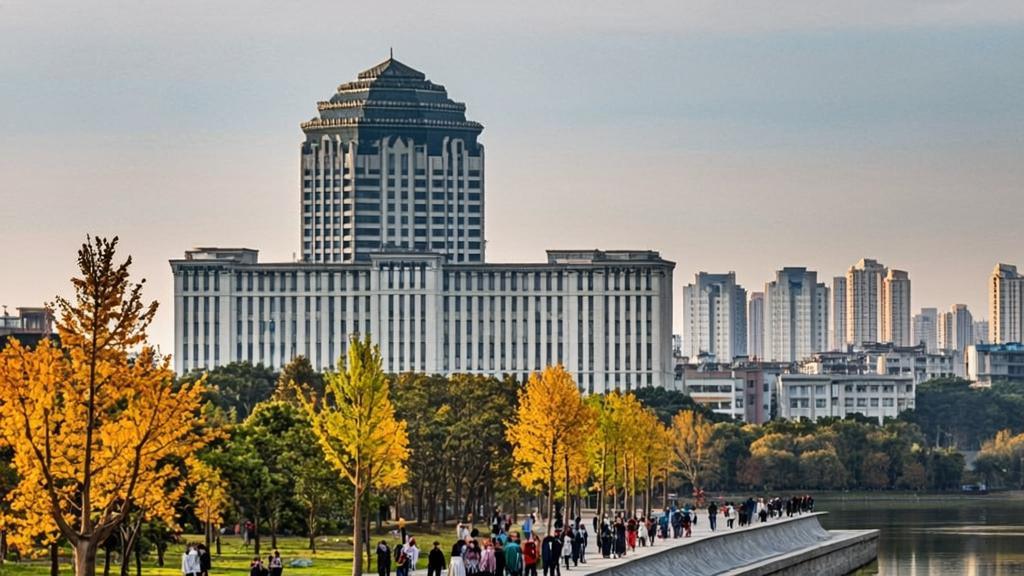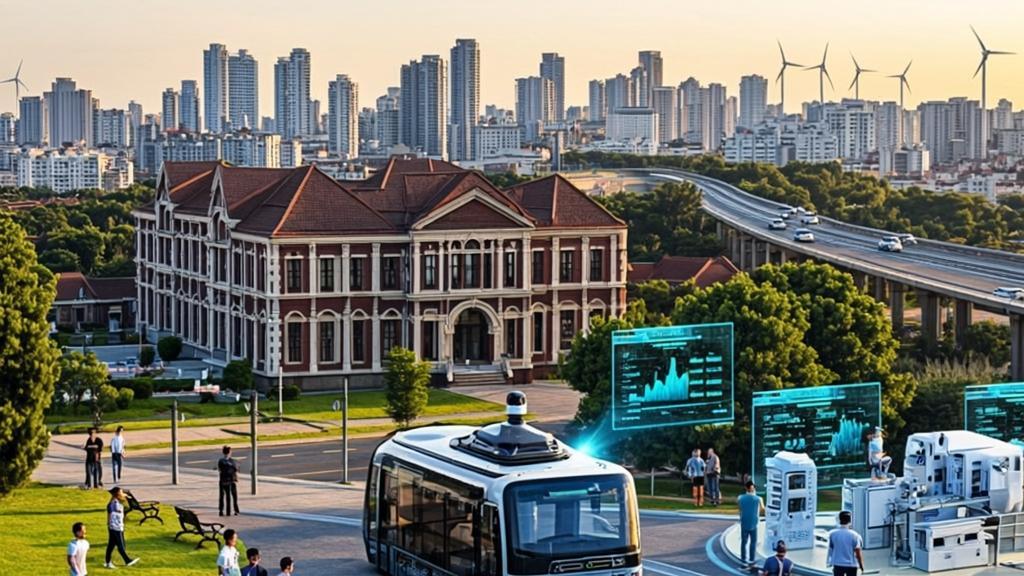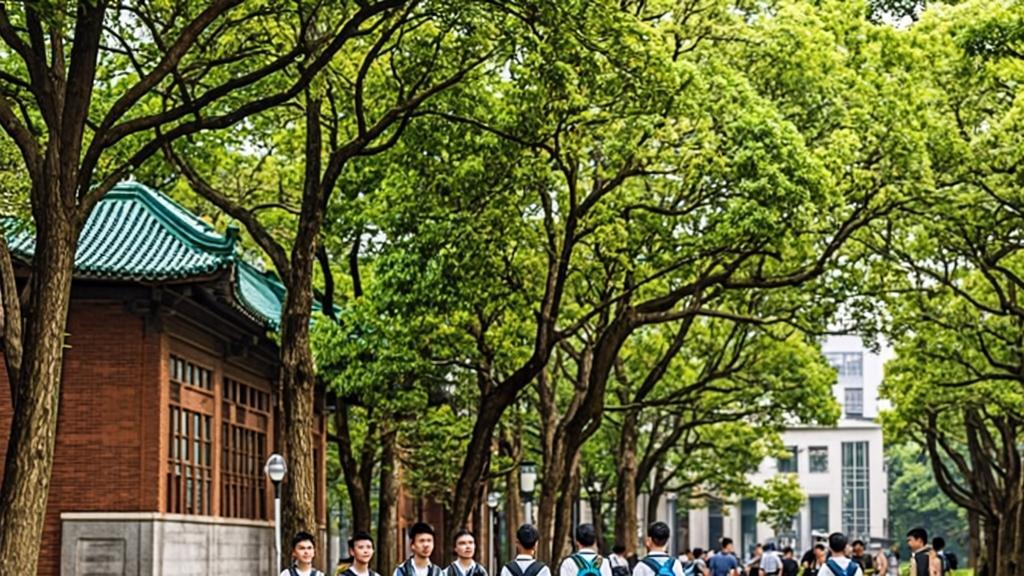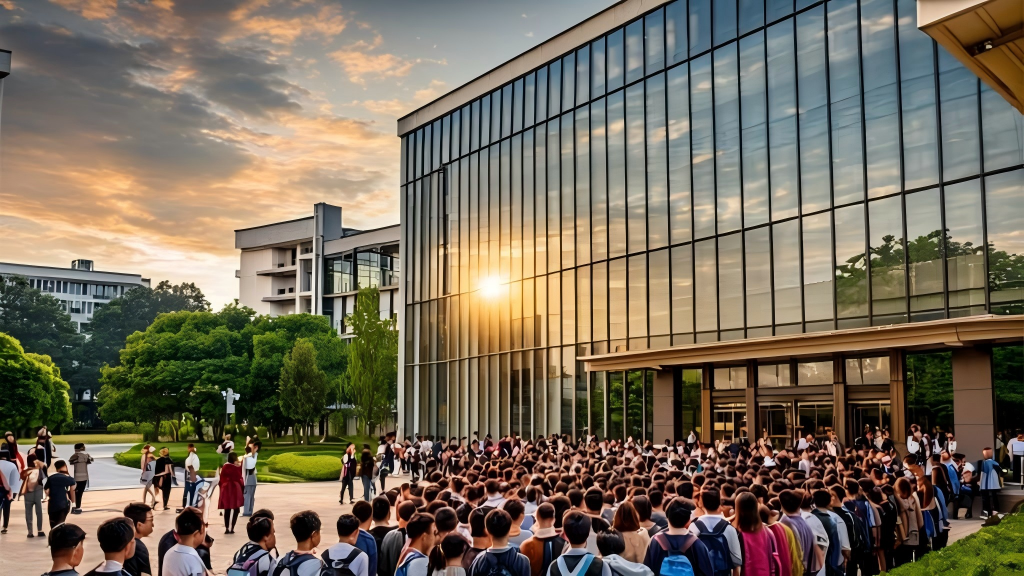
The University of Science and Technology of China is a place that incorporates “cutting-edge” into its emblem and treats “black technology” as breakfast. While other schools are still struggling with the “Double First Class” policy, it has quietly sent quantum satellites into space, breaking the world record for fiber optic quantum communication (USTC News, 2023). Today, let’s not talk about rankings, let’s talk about humanity: what kind of life would you have if you were to come here to study?
Morning opening method of the University of Science and Technology of China: 7:30 in the East District Library
You may have heard of the term involution, but in the East Library, people are more accustomed to saying cabin grabbing – the socket seats by the window are jokingly referred to as spaceship cabins.
The door opens at seven o’clock, and the queue turns to the flower bed at 6:30.
Don’t worry, this is not anxiety, it’s more like a ritual: “formatting” the morning brain so that new knowledge can be written in.
On the first floor of the library, there is a “Guo Award Coffee” named after the “Guo Moruo Scholarship”. The popular latte is called Fresnel Reflection, and the cocoa powder sprinkled on the milk foam is an interference stripe pattern.
While sipping coffee and flipping through papers – oh, this is really the University of Science and Technology of China.
Classroom Scene at the University of Science and Technology of China: Formulas that cannot be written on the blackboard are directly labeled as “Zuchong”
Is it still not enough to fill four blackboards with differential geometry? The teacher took out a laptop and remotely connected it to the “Zu Chong Zhi” superconducting quantum processor, running a 66 bit random line sampling on site (Song et al., 2021).
The students did not take photos with their phones, but put on headphones – the classroom synchronously pushed real-time calculation curves to iPads.
In other words, quantum computing is no longer limited to PPT, it has become an experimental tool.
After class, the teaching assistant posted a GitHub link in the WeChat group, encouraging “if you have free time, please submit a PR”.
So, at 2 o’clock in the morning, you can still see the commit record: Fix typo in qubit mapping.
What I mean is that the speed of knowledge iteration far exceeds that of a sprint.
Undergraduate research: a sophomore may have a dedicated “ion trap”
Joining the group is the sexiest word on campus.
According to school regulations, as long as the supervisor nods, sophomore students can take “Research Practice” credits.
The list of high-end platforms is outrageously long –
- National Synchrotron Radiation Laboratory
- Steady State Strong Magnetic Field Center
- National Laboratory of Quantum Information Science
Let me give you a fresh example: A junior student from Nanjing in the 2024 class followed the team of Academician Du Jiangfeng to do “single-molecule magnetic resonance imaging” and managed to get a second article in a Nature journal within six months (USTC News, 2024).
Is the key to mixing? No, the key is that the platform is truly open to undergraduate students, rather than hanging on the bulletin board and gathering dust.
Graduate Life at the University of Science and Technology of China: When “996” Meets “613”
If the undergraduate pace at the University of Science and Technology of China is like a heartbeat, and graduate students are like playing drums – 613 is a secret code: enter the laboratory at 6am, return to the dormitory at 1pm, 7 days a week.
Does it sound hopeless? Actually, many people volunteer.
Here is the only collider elevator in the country: when you sit on it, your phone signal instantly resets to zero, and as soon as the door opens, you are standing next to the detector of Beijing Spectrometer III.
Many doctoral students have expressed that “overtime” is not about exploitation, but about “reluctance to leave”.
Fresh data is out, who is willing to shut it down?
Interdisciplinary: When chemists learn “programming,” chemistry becomes “computation”
In recent years, the school has vigorously promoted New Medicine+X.
The School of Life Sciences shares a medical record database with the First Affiliated Hospital (Anhui Provincial Hospital), and combines AI algorithms from the School of Information Science to jointly publish a NEI subjournal.
Even more exaggerated is the Medical Engineering Integration course, which transforms the operating room into a classroom.
The professor pushed the da Vinci surgical robot into the classroom and asked the students to practice suturing with pig liver.
The school explains that it aims to cultivate “surgeons who understand code” or “algorithm engineers who understand anatomy”.
It sounds magical, but it does solve the long-standing problem of “language barrier” in two fields.
In other words, the University of Science and Technology of China specializes in governance that is like a mountain separated by a road.
Leaving the campus: Hefei is not a “county town”, but a jungle of “large scientific facilities”
Don’t be fooled by the label of “second-tier city”.
Hefei is home to four major scientific facilities, including synchrotron radiation, a fully superconducting tokamak, a steady-state strong magnetic field, and comprehensive research facilities for key systems of fusion reactor hosts…
With just one swipe of the bus card, you can reach the “Science Island” in half an hour.
Do you want to change your mind this weekend? Go cycling on the Quantum Avenue – along the route, Guodun Quantum, Benyuan Quantum, and Huawei Quantum Laboratories are gathered.
The owner of a roadside coffee shop will enthusiastically explain: “Do you know what encryption our Wi Fi uses? Quantum key! ”This is not a marketing gimmick, but rather the fact that the Feishi government is really piloting a “satellite ground integrated” secure communication network.
Application tip: Don’t let the “math competition” scare you away
Many people think that the University of Science and Technology of China only accepts Olympic gold medals.
In fact, in recent years, the proportion of national college entrance examination enrollment has exceeded 60%, and comprehensive evaluation also welcomes research potential stocks.
The key lies in the word “scientific research”: as long as you have done open-ended projects and written some practical reports, you are already ahead.
Language score? TOEFL 100+is sufficient, but don’t just submit scores – it’s best to include a research statement, such as writing about the data measured by the small spectrometer you built on your balcony at home.
The admissions teacher revealed that they want to see hands-on traces rather than exam traces.
Summary: Turning “hardcore” into everyday magic
The University of Science and Technology of China is not perfect, with the cafeteria occasionally dark and the winter breeze pouring in.
But here, “high-energy physics” is written into bread fermentation, the “Tianwen-1” algorithm is used as a graduation project, and even undergraduate students are given exclusive superconducting chips.
If what you crave is not just a degree, but pushing the unknown forward by 0.1 nanometers with your own hands, then come here, write the formula into the morning mist, and pack the galaxy into a suitcase.
The next “Zuchong Hao” may be waiting next to your dormitory.
References
- Song, C., Zhang, J., Liu, W., & Pan, J. W. (2021). Quantum computational advantage using photons. Science, 372(6539), 78-83. https://doi.org/10.1126/science.abe8770
- USTC News. (2023). 1002 km fiber quantum key distribution record. https://news.ustc.edu.cn/info/1177/7613.htm
- USTC News. (2024). Undergraduate co-author in Nature sub-journal. https://news.ustc.edu.cn/info/1179/8247.htm