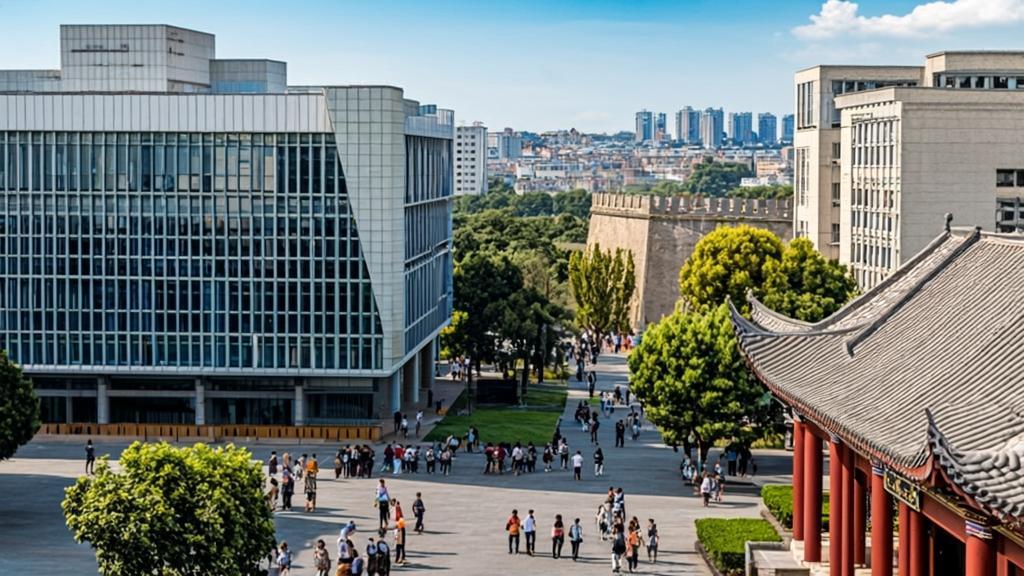
Xi’an Jiaotong University sits at the eastern end of the ancient Silk Road. For over 2,000 years, caravans carrying silk, spices, and ideas passed through Xi’an on their way to Central Asia, Persia, and Rome. Today, students from 136 countries make that same journey — not for trade, but for education. And most of them say the same thing afterward: nobody warned them how good it would actually be.
The City That Rewrites Your Expectations
Before diving into the university itself, you need to understand Xi’an.
Most people associate it with the Terracotta Warriors. That’s fair. But Xi’an was also the capital of 13 dynasties in Chinese history — including the Han and Tang, the two greatest empires China ever produced. The Tang Dynasty, in particular, was arguably the most cosmopolitan civilization on earth at the time. Merchants, monks, diplomats, and musicians from across Eurasia lived side by side in Tang-era Xi’an.
In a way, that energy never left.
Today, Xi’an hosts over 100 branches of Fortune 500 companies. It’s a hub for AI, aerospace, biotech, and chip manufacturing (XJTU International Education Brochure, 2024–2025). The ancient Silk Road city and the modern tech corridor are, somehow, the same place. For international students, that contrast is one of the first things that hits you.
Why Xi’an Jiaotong University Is Not a Backup Choice
Some students arrive at Xi’an Jiaotong University thinking of it as a “second-tier” option — a fallback after Beijing or Shanghai. That assumption fades quickly.
For 2025, XJTU ranks:
- #92 globally — Academic Ranking of World Universities (ARWU)
- #141 — U.S. News & World Report Best Global University Rankings
- #20 in the Asia-Pacific region — Nature Index 2025
- Top 10 comprehensive research universities in China
It is the only university in Western China that belongs to the C9 League — China’s equivalent of the Ivy League (Wikipedia, Xi’an Jiaotong University, 2025). Moreover, in 2024, XJTU earned a Class A+ rating in China’s official re-certification of higher education quality for international students. That is the highest possible score (XJTU General Information, en.xjtu.edu.cn).
In short, this is not a compromise. It’s a deliberate choice.
The Silk Road Connection Is More Than a Metaphor
Here’s where the story gets genuinely interesting.
In 2015, Xi’an Jiaotong University founded the University Alliance of the Silk Road (UASR). As of 2025, it has grown to include 207 universities across 45 countries and regions (UASR Introduction, uasr.xjtu.edu.cn). The alliance connects institutions across Central Asia, the Middle East, South Asia, Eastern Europe, and beyond — precisely the regions the original Silk Road once linked.
This matters for students because the UASR is not just symbolic. It drives real exchange programs, joint research, and degree partnerships. If you come from Kazakhstan, Pakistan, Uzbekistan, or Turkey, there is likely already an active institutional bridge between your home university and XJTU.
To compare this to something Western audiences understand: think of it like the Bologna Process in Europe, which created a unified higher education space across 49 countries. The UASR is building something similar for the Eurasian corridor — and XJTU is the hub.
Furthermore, the modern Silk Road runs through Xi’an in a very literal sense. In the first half of 2025 alone, 3,055 China-Europe Railway Express trains departed from Xi’an’s international port, carrying 3.45 million tons of cargo — a 34.8% year-on-year increase (Science and Technology Daily, XJTU, 2025). The logistics infrastructure that connects Xi’an to the world also connects the students who study there.
What the Campus Is Actually Like
Currently, nearly 3,929 international students from 136 countries study at XJTU (XJTU Introduction, xjtlu.edu.cn). The university has four campuses: Xingqing, Yanta, Qujiang, and the newest iHarbour — a science and technology innovation port built specifically for research at the frontier.
A few things international students consistently note:
- The scale surprises people. Over 62,000 students total, spread across 250+ hectares. It’s closer to a small city than a campus.
- English-taught programs exist. XJTU offers a range of undergraduate and graduate programs taught entirely in English, particularly in engineering, medicine, and management.
- The food culture is its own education. Xi’an’s Muslim Quarter and its famous rou jia mo (often called China’s original burger) have been feeding travelers for centuries. For students from the Middle East and Central Asia especially, the city’s halal food culture feels unexpectedly familiar.
XJTU vs. Western University Culture: A Few Honest Comparisons
Western students often ask: Is it similar to studying in Europe or the US?
The honest answer is: partially.
The research environment at XJTU compares favorably to mid-tier European research universities in terms of output. The 2025 CWTS Leiden Ranking placed XJTU 8th in the world by total scientific publications (Wikipedia, Xi’an Jiaotong University, 2025). The library on the Xingqing campus holds over 5 million books and 1 million electronic resources.
Where it differs is the campus culture. Chinese academic culture places high value on collective effort, mentorship hierarchies, and structured routine. This can feel rigid at first to students from more informal Western systems. However, many graduates describe it as ultimately grounding — similar to how students from individualistic cultures often find value in the discipline of, say, German engineering programs.
Another contrast: the cost of living. Xi’an is significantly cheaper than Beijing, Shanghai, or most Western cities. Monthly living costs for a student typically fall between 2,000 and 4,000 RMB (\$280–\$560 USD). For context, that is comparable to some Eastern European cities, but with far higher purchasing power in terms of local services.
Scholarships: The Financial Reality
Cost, however, is often not the main obstacle. Awareness is.
XJTU participates in the Chinese Government Scholarship (CSC), one of the most comprehensive international scholarship programs in the world. For graduate students, it covers:
- Full tuition waiver
- Free on-campus accommodation
- Monthly stipend: 3,000 RMB for Master’s students, 3,500 RMB for PhD students
- Comprehensive medical insurance
- Free Chinese language courses (XJTU Scholarships, sie.xjtu.edu.cn)
Additionally, XJTU offers its own Siyuan International Student Scholarship, which provides stipends of up to 4,500 RMB per month for doctoral students (China Admissions, apply.china-admissions.com).
Furthermore, the XJTU-Xi’an City Government “Belt and Road” International Student Scholarship specifically targets students from countries along the Silk Road corridor. It’s one of the few university scholarships in the world tied directly to geopolitical and cultural history.
The application deadline for the 2026–2027 cycle is March 31, 2026 (Greatyop, 2026).
What Makes This Different From Studying in Beijing or Shanghai?
That question comes up a lot — and the answer is more nuanced than most guides admit.
Beijing and Shanghai offer prestige and cosmopolitan lifestyle. Yet Xi’an offers something harder to quantify: depth. When you study in a city that was once the center of the known world, history becomes ambient. You walk past Tang Dynasty city walls on the way to an AI research lab. That combination does something to how you think about time, civilization, and innovation.
There is also the practical matter of competition. International students in Beijing compete for attention, housing, and network access in an extremely saturated environment. Xi’an, by contrast, is the dominant academic hub for an entire region of nearly 300 million people — yet it remains underrepresented in English-language student media. That gap is, arguably, the real opportunity.
Is Xi’an Jiaotong University the Right Move?
That depends entirely on what you’re looking for.
If you want a top-tier research institution, a culturally rich city, genuine Silk Road connections, and scholarship options that are rarely discussed in Western media — then yes. Xi’an Jiaotong University is one of the most underrated international study destinations in the world right now.
The caravans have changed. The route, remarkably, has not.
References
- Wikipedia contributors. (2025). Xi’an Jiaotong University. Wikipedia. https://en.wikipedia.org/wiki/Xi%27an_Jiaotong_University
- Xi’an Jiaotong University. (2025). General information. en.xjtu.edu.cn. https://en.xjtu.edu.cn/2025-07/02/c_1105002.htm
- Xi’an Jiaotong University, School of International Education. (2024). International education brochure 2024–2025. sie.xjtu.edu.cn. https://sie.xjtu.edu.cn/en/2024all_en.pdf
- University Alliance of the Silk Road. (n.d.). Introduction to UASR. uasr.xjtu.edu.cn. https://uasr.xjtu.edu.cn/About_UASR/Introduction.htm
- Xi’an Jiaotong University & Science and Technology Daily. (2025, August 25). XJTU international students experience China’s tech-driven life. en.xjtu.edu.cn. http://en.xjtu.edu.cn/2025-08/25/c_1119126.htm
- Xi’an Jiaotong-Liverpool University. (2025). XJTU introduction. xjtlu.edu.cn. https://www.xjtlu.edu.cn/en/xjtu-intro
- Xi’an Jiaotong University, School of International Education. (n.d.). Chinese Government Scholarships. sie.xjtu.edu.cn. http://sie.xjtu.edu.cn/en/SCHOLARSHIPS1/Chinese_Government_Scholarships.htm
- China Admissions. (n.d.). XJTU Siyuan International Student Scholarship. apply.china-admissions.com. https://apply.china-admissions.com/scholarship/xjtu-siyuan-international-student-scholarship/
- Greatyop. (2026, January 16). Xi’an Jiaotong University’s scholarships program, 2026–2027. greatyop.com. https://greatyop.com/scholarships-xian-jiaotong-university/