Xiaolongbao might be the most closely studied dumpling on earth. Not because food critics have endlessly debated it — though they have. But because one American chef actually pulled out a set of precision calipers, a digital scale, and a pair of hairdresser’s scissors, and turned Shanghai’s most beloved street snack into a spreadsheet. The story is absurd. However, it is also, surprisingly, one of the most useful things any food lover has ever done for travelers heading to China.
What Even Is Xiaolongbao? A 30-Second Primer
Before the numbers, a quick grounding.
Xiaolongbao is a small, pleated steamed bun filled with seasoned pork and hot broth. The name literally means “small basket bun.” Steam a basket, and the cold pork jelly inside melts into liquid soup. That is the magic trick — and also why first-timers always burn their tongues.
The dish originated in Nanxiang, a town now part of Shanghai’s Jiading District, around 1871 (Urban China Travelogue, 2025). Today, Nanxiang Steamed Bun Restaurant at Yu Garden — the brand’s historic downtown outpost, founded in 1900 — remains one of the most visited food stops in all of Shanghai. Moreover, in 2014, the Nanxiang xiaolongbao making technique was officially listed as a National Intangible Cultural Heritage of China (China News Service, 2014).
So yes. This is a very serious dumpling.
The Man With the Calipers: Christopher St. Cavish
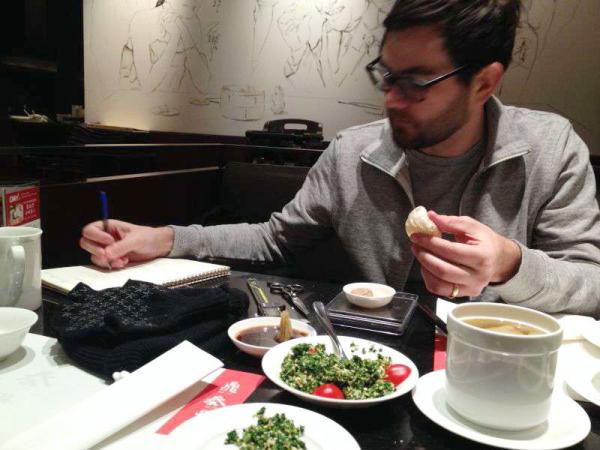
Christopher St. Cavish is an American chef-turned-food writer who has lived in Shanghai for over a decade. Between December 2013 and October 2014, he visited 52 restaurants. In total, he consumed 7.243 kg of xiaolongbao — roughly 16 pounds — at a total cost of 712.5 RMB.
His toolkit was simple on purpose:
- A Kubei 200g/0.01g digital scale
- A pair of Mitutoyo 0-150mm digital calipers (Model 500-196-20)
- Hairdresser’s scissors to cut each dumpling apart cleanly
At every restaurant, St. Cavish ordered a standard basket of six. He then dissected each one carefully. First, he weighed the whole dumpling. Next, he drained and weighed the soup alone. After that, he extracted the meatball and weighed it separately. Finally, he used the calipers to measure the skin thickness in fractions of a millimeter.
He scored each shop against the three classic Shanghai standards for a good xiaolongbao: thin skin (皮薄, pí báo), plentiful soup (汁多, zhī duō), and abundant filling (馅大, xiàn dà). Furthermore, any restaurant caught using MSG was disqualified. So was any shop where two out of six dumplings broke during handling — a clear sign of poor craft (St. Cavish, as cited in CNN Travel, 2015).
The result was The Shanghai Soup Dumpling Index, published in 2015. It went viral almost immediately. CNN covered it. The China Daily ran a profile on him. Thousands of copies sold worldwide.
What the Data Actually Revealed About Xiaolongbao
The top-scoring restaurant, Zun Ke Lai, hit a score of 24.32 — far ahead of every competitor. Its average dumpling weighed 27.1g. The skin measured just 0.72mm, roughly the thickness of a credit card. Yet, remarkably, it held together under 5.08g of soup and 12.42g of filling (Xtreme Foodies, 2015).
For comparison, Din Tai Fung — the globally known Taiwanese chain — scored a solid Class A score of 13.86. Its average skin was 1.04mm. Consistent, clean, reliable. Still, not the thinnest.
What does that tell us? Two things, specifically.
First, standardization and quality are not the same thing. Din Tai Fung has built a global brand on consistency. Every dumpling has 18 pleats. Every wrapper weighs exactly 21g. In many ways, it is the McDonald’s of xiaolongbao — and that is not necessarily a criticism. However, small Shanghai family shops, built on inherited recipes, can still out-perform the global chain when everything comes together.
Second, the numbers simply confirmed what locals already knew. Shanghai has hundreds of xiaolongbao shops. Most are average. Only a handful are truly extraordinary. Without a caliper, tourists often end up at the famous ones, rather than the best ones.
A Cultural Aside: Is This Very Western?
Here is an interesting question worth pausing on.
In the West, food criticism has a long tradition of trying to be objective. For instance, the Michelin Guide uses secret inspectors and a three-star scale. Similarly, wine rating systems like Robert Parker’s 100-point method reduce a personal experience to a number. In theory, these systems cut out personal bias. In practice, though, they simply create new kinds of hierarchy.
St. Cavish’s xiaolongbao index fits right into that tradition. Indeed, he says the goal was “a quantitative interpretation of the colloquial standards for a well-constructed soup dumpling” (St. Cavish, as cited in Sam Gaskin, 2015).
But here is the key difference. Chinese food culture has always had its own quality standards. The three-part rule — thin skin, plentiful soup, abundant filling — is not a Western idea. Rather, it is a folk standard passed down through generations of Shanghai diners. St. Cavish did not create those standards. Instead, he simply gave them a measuring tool.
In that sense, the index is less an outside view and more a cross-cultural bridge. He took Chinese folk wisdom and gave it a language that data lovers anywhere on earth could follow and respect.
That is, honestly, a pretty thoughtful thing to do.
Where to Eat Xiaolongbao in Shanghai Right Now (2025–2026)
The Index was researched back in 2013–2014. Shanghai’s food scene, however, moves fast. So here are the current top picks, updated for 2025–2026:
Lai Lai Xiao Long (来来小笼) Currently the top pick among serious food lovers. Specifically, the Tianjin Road location earned a Bib Gourmand in the Michelin Guide Shanghai 2025. Thin wrappers, a river of soup, crab roe options available. Go after 1:30 PM to avoid the lunch crowd. Address: 504 Tianjin Rd, Huangpu District.
Nanxiang Mantou Dian at Yu Garden (南翔馒头店) Founded in 1900, this spot also holds a Bib Gourmand. It is convenient if you are already visiting Yu Garden and the Bund. Expect queues. The crab roe version is seasonal and well worth the extra cost (Rachel Gouk, 2026).
Jia Jia Tang Bao (佳家汤包) A no-frills local institution. Cash only at some locations. St. Cavish himself recommends it after finishing the Index. The crab pork blend is a standout. Arrive early — they sell out fast.
Guyi Garden Restaurant, Nanxiang (古猗园餐厅) The original birthplace of the dish. Take Metro Line 11 to Nanxiang. More rustic than downtown options. Moreover, the experience here carries real historical weight — this courtyard is where xiaolongbao was born over 150 years ago.
How to Eat a Xiaolongbao Without Burning Yourself
This part is genuinely practical. Most first-timers make one of three mistakes.
- Biting straight in. The soup inside is close to boiling. You will regret it immediately.
- Lifting too hard. The skin tears, the soup spills, and everyone at the table feels your pain.
- Skipping the vinegar. A mix of black Zhenjiang vinegar and thin ginger slivers always comes alongside. It is not optional garnish.
The correct steps, in order:
- Lift the dumpling gently with chopsticks from the pleated top, where the skin is thickest.
- Place it in your soup spoon. Do not skip the spoon.
- Nibble a small hole in the side.
- Sip the broth first.
- Then dip in vinegar.
- Finally, eat the rest in one or two bites.
Shanghai locals call this “一口开天窗” — “one bite opens the skylight.” It is a ritual, not just a technique. Therefore, take your time with it.
Why This Story Should Make You Book a Flight
St. Cavish once noted that traveling for food in China is harder than it should be — the language barrier, the unreliable guides, the tourist traps. However, that is precisely why a story like the Xiaolongbao Index matters to travelers.
It shows that this city takes its food seriously enough that someone spent 16 months and a set of engineering calipers just to figure out which one is best. That level of care, applied to a bun that costs less than a dollar, is something you simply cannot fake.
Consider this: xiaolongbao is a National Intangible Cultural Heritage, a street snack sold for pocket change, and the subject of a viral scientific study — all at the same time. As a result, few dishes on earth carry that combination of depth and accessibility. That layered richness is, ultimately, what makes Chinese food culture worth experiencing in person — not just reading about online.
Come hungry. Bring patience. Leave room for at least two baskets.
References
China News Service. (2014, August 14). 南翔小笼制作入选国家非遗 有143年历史. Chinanews.com. https://www.chinanews.com/cul/2014/08-14/6491770.shtml
Gouk, R. (2026, February 3). Best xiao long bao in Shanghai (updated 2025). RachelGouk.com. https://rachelgouk.com/the-best-xiao-long-bao-in-shanghai/
Gaskin, S. (2015, April 25). Xiaolongbao Index author Chris St Cavish. SCGaskin.WordPress.com. https://scgaskin.wordpress.com/2015/04/25/xiaolongbao-index-author-chris-st-cavish/
Hunt, K. (2015, April 22). Where to find the best soup dumplings in Shanghai. CNN Travel. https://www.cnn.com/travel/article/shanghai-soup-dumpling-index/index.html
Urban China Travelogue. (2025, November 3). Shanghai xiaolongbao: History, craftsmanship & culinary guide. UrbanChinaTravelogue.com. https://urbanchinatravelogue.com/shanghai-xiaolongbao-guide/
Wang, C. (2018, November 28). From molecular gastronomy to the written word. China Daily. http://www.chinadaily.com.cn/a/201811/28/WS5bfdac5fa310eff30328b61a.html
Xtreme Foodies. (2015, December 9). Shanghai’s 7 essential soup dumplings: Xiaolongbao. XtremeFoodies.com. https://www.xtremefoodies.com/features/essential-eats/shanghai-soup-dumplings-xiaolongbao