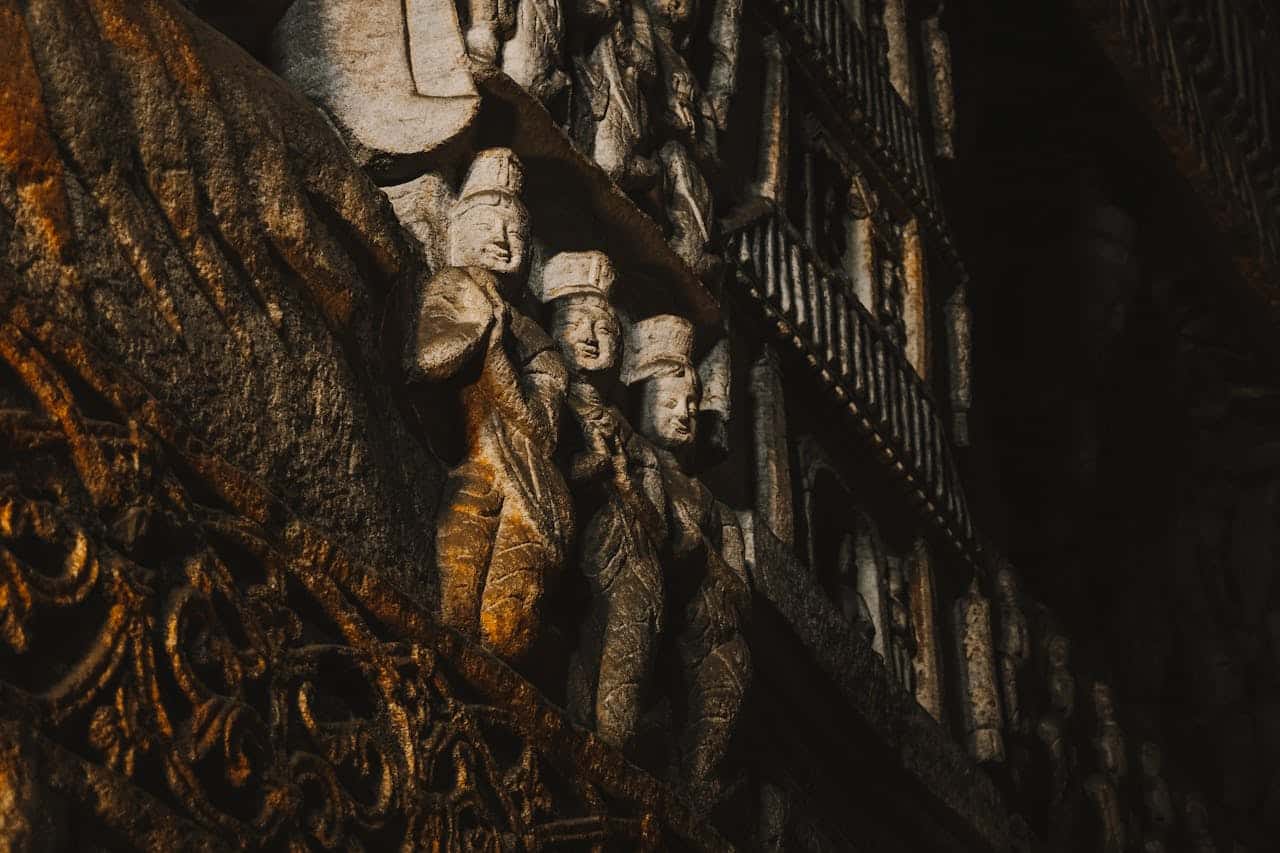
The Yungang Grottoes don’t look like a crossroads. From the outside, they’re a long sandstone cliff face in northern Shanxi, roughly 16 kilometers west of a mid-sized Chinese city called Datong. But step inside Cave 12 — the one locals call the “Music Cave” — and something unexpected happens.
You’re looking at a Persian harp. Then a Central Asian five-stringed lute from the Kucha region. Then a panpipe, a transverse flute, a zheng. All carved in stone. All played by celestial musicians frozen mid-performance on a wall that’s been here since the 5th century CE. This isn’t a purely Chinese Buddhist site. It never was. The Yungang Grottoes are, in many ways, the ancient world’s most ambitious multicultural project — and most international visitors walk right past the evidence without realizing what they’re seeing.
Why the Yungang Grottoes Matter Beyond Buddhism
Most travel guides describe this UNESCO World Heritage Site in religious terms: 45 caves, 51,000 Buddha statues, carved during the Northern Wei Dynasty (460–524 CE). All true. But that framing misses something significant.
UNESCO’s own designation calls the Yungang Grottoes “a masterpiece of early Chinese Buddhist cave art” that “represent the successful fusion of Buddhist religious symbolic art from south and central Asia with Chinese cultural traditions” (UNESCO World Heritage, 2001). That word — fusion — is doing real work here.
The Northern Wei rulers who commissioned these caves were not Han Chinese. They were the Tuoba clan, a Turkic-speaking people from the north. They had just unified a fractured China, adopted Buddhism as their state religion, and built their capital at what is now Datong. The Silk Road ran directly through their territory. So when they hired craftsmen and monks to carve these caves, they weren’t drawing from one tradition. They were pulling from everything the Silk Road brought to their doorstep: Indian iconography, Persian decorative motifs, Greek sculptural aesthetics, Central Asian musical instruments, and traditional Chinese art forms.
The result is genuinely unlike anywhere else in the world.
Cave 12: The Music Cave and the World’s First Playlist
Cave 12 is, on the surface, easy to overlook. It sits within the “Five Magnificent Caves” (Caves 9–13), a cluster in the central section of the Yungang Grottoes. Other caves get more attention — Cave 5 has the tallest indoor Buddha in the complex (17 meters), and Cave 20 with its famous open-air Buddha is the site’s unofficial symbol.
But Cave 12 tells a different story. Its walls are densely carved with musicians, dancers, and flying celestial figures. Look closely at the instruments in the musicians’ hands. Research from Shanxi Datong University has identified over 530 instrument images across Yungang’s caves, representing 28 distinct instrument types (Jia & Jia, 2023). In Cave 12 and the surrounding middle-period caves, approximately 81% of identifiable instruments originated from the Western Regions — meaning Central Asia, Persia, and India.
Specifically, visitors can find:
- The Persian vertical harp (竖箜篌, shù kōnghóu) — a Western Asian instrument that traveled east along the Silk Road
- The five-stringed kuyu lute from Kucha (modern Xinjiang) — distinct from the Chinese four-stringed pipa
- Indian-style drums — thin-waisted and thick-waisted forms from South Asian musical traditions
- Han Chinese instruments — the panpipe (排箫), the zheng (筝), the transverse flute (横笛)
All in the same cave. All played together by the same celestial ensemble.
There’s nothing quite like this in Western art history. The closest analogy might be a medieval European cathedral that somehow incorporated Islamic geometric patterns, Byzantine mosaics, Roman architectural columns, and Norse carved motifs into a single coherent interior. That kind of synthesis didn’t really happen in Europe. It happened here, in a sandstone cliff in Shanxi.
Why the Buddha Faces Look Foreign
Here’s something that surprises many first-time visitors. Walk up to one of the early Yungang statues — particularly those in Caves 16–20, the “Tan Yao Five Caves” carved first, around 460 CE — and the faces look unusual. Deep-set eyes. High noses. Strong, broad cheekbones. Cave 20’s famous open-air Buddha, the site’s symbolic centerpiece, has a face that genuinely doesn’t look East Asian at all.
This is Gandharan influence. Gandhara was a region centered in what is now northwestern Pakistan and Afghanistan, where Greek artistic traditions had fused with Buddhist iconography following Alexander the Great’s campaigns in the 4th century BCE. The result — often called Greco-Buddhist art — spread eastward along the Silk Road for centuries. By the time it reached Datong, Buddha statues looked like a fusion of a Greek god and an Indian spiritual master.
As Britannica notes, the predominant sculptural style of the Yungang statues “is a synthesis of various foreign influences — including Persian, Byzantine, and Greek — but ultimately derived from the Buddhist art of India” (Britannica).
Then something interesting happens. As you move through the caves chronologically — early (Caves 16–20), middle (Caves 1–13), late (Caves 21–45) — the faces change. Later statues become more refined, more delicate, more recognizably Chinese in aesthetic. The bodies slim. The robes flow differently. The transition from Central Asian-influenced to Sinicized Buddhist art is literally visible as you walk through the site.
Smarthistory, an academic art history platform, describes this transformation clearly: Yungang demonstrates “how various artistic traditions of South, Central, and East Asia were integrated and remixed to create something new” (Zhao, Smarthistory, 2020). This artistic evolution, playing out across 45 caves, is one of the most remarkable things a visitor can trace on foot.
Comparing Yungang to Western Sacred Architecture
For visitors from Europe or the Americas, it helps to put this in a familiar frame. Think of what the Cathedral of Notre-Dame in Paris represents: a fusion of Romanesque and Gothic traditions, built over centuries, incorporating influences from across medieval Europe. It’s layered, multicultural in its own way, and shaped by history.
The Yungang Grottoes are somewhat like that — except the fusion is more dramatic, more geographically vast, and happened faster. Within roughly 60 years of construction, craftsmen synthesized artistic traditions stretching from the Mediterranean coast to the Bay of Bengal into a single coherent site.
Unlike Notre-Dame, which was modified gradually by people largely within the same cultural tradition, Yungang was built at a junction. The Northern Wei rulers were Central Asian steppe people who had conquered northern China and needed to build cultural legitimacy fast. Buddhism, traveling in via the Silk Road, gave them the framework. And the Silk Road brought the artists, the instruments, the iconography, and the techniques to fill it out.
The sociological dynamic, interestingly, isn’t entirely unlike the Roman Empire’s approach to Greek culture — absorbing it, repackaging it, and presenting the synthesis as a statement of power and sophistication. The Yungang Grottoes were also a political project, not just a religious one. Each colossal Buddha in the Tan Yao Five Caves represented one of the first five Northern Wei emperors. The message to subjects was clear: our emperors are incarnations of the Buddha himself.
Must-See Caves: A Practical Breakdown
Allow at least 3–4 hours. The site stretches roughly 1 kilometer east to west, and shuttle buses run between the main entrance and key caves.
Caves 16–20 (Tan Yao Five Caves) — Start here. These are the oldest, carved first under monk Tan Yao. The statues are massive, muscular, and strongly influenced by Gandharan and Central Asian styles. Cave 20’s open-air Buddha (13.7 meters) is the site’s most photographed image.
Caves 5 and 6 — Cave 5 houses the 17-meter seated Buddha, the tallest indoor statue in the complex. Cave 6 is often called “the First Cave of Yungang” for its extraordinary density of carvings — every surface covered, a central pillar rising floor to ceiling, 33 relief panels narrating the life of Shakyamuni.
Cave 12 (Music Cave) — Essential for understanding the Silk Road dimension. Take time here. Look carefully at each musician’s instrument and try to identify where it came from geographically.
Cave 8 — Contains a remarkably rare figure: an eight-armed, four-headed Hindu deity Shiva, riding a bull. Hindu imagery inside a Buddhist cave. The syncretism here is extraordinary, and this cave gets far less attention than it deserves.
Caves 9 and 10 — Notable for their palace-style carved entrance facades, which mimic wooden Chinese architecture in stone. Also contain musician figures and elaborate decorative programs.
Best Time to Visit the Yungang Grottoes
The best visiting period runs from April to October, with spring (April–June) and early autumn (September–October) offering the most comfortable conditions. Temperatures are mild, rainfall is low, and natural light enhances the carvings best around mid-to-late afternoon.
Avoid July 20 to August 20 if possible — this is peak domestic family travel season and crowds can be significant. Also avoid May 1–5 (Labor Day Golden Week) and October 1–7 (National Day Golden Week).
Afternoon light tip: For photography, the grottoes face south. Around 3 PM, natural light enters many caves at an angle that reveals carving details otherwise invisible in flat noon light.
How to Get to the Yungang Grottoes
From Beijing by high-speed train: The fastest option. Trains from Beijing North Station reach Datong South Station in roughly 2 hours. From there, taxis to the grottoes take 30–40 minutes and cost approximately 50–70 RMB. Bus No. 31 from the station connects to a transfer for tourist bus No. 603 direct to the grottoes.
Bus from Datong city center: Bus No. 3 from Gongjiao Sigongsi Station (公交四公司站) runs to the grottoes and costs 4 RMB. Journey time is 20–30 minutes.
By car or taxi: About 20 km from central Datong, 30–40 minutes depending on traffic.
Tickets and Booking (2025 Rules)
As of January 1, 2025, Yungang Grottoes requires online real-name reservation for all visitors. Same-day tickets are no longer available; book up to 7 days in advance (Yungang Grottoes official notice).
- Peak season ticket (April–October): 120 RMB per person
- Off-season ticket (November–March): 100 RMB per person
- Daily visitor cap: 46,000 visitors
Book via the official WeChat mini-program “Yungang Research Institute” or through Trip.com. Foreign passport holders can check in at Entrance No. 3 with original ID.
The site now accepts foreign bank cards and provides English-speaking tour guides, English signage, and on-site English consultation services. An immigration service station at the Tourist Service Center offers visa appointments and emergency assistance for international visitors (China Daily, 2025).
Local Food: What to Eat in Datong
After the grottoes, Datong offers one dish that deserves a special detour.
Daoxiao mian (刀削面) — Knife-cut noodles. This is Datong’s culinary identity. A chef balances a block of wheat dough on one arm and shaves thin ribbons directly into boiling water using a curved blade. A skilled master can produce over 200 strands per minute (Wikipedia, Knife-cut noodles). The result is thick, chewy, jagged-edged noodles that absorb broth and chili oil in a way that smoother noodles can’t match. Served in beef or mutton broth, always with a splash of Shanxi aged vinegar.
Shanxi aged vinegar. Shanxi is known throughout China as “the home of vinegar.” The province’s aged variety ferments for years and has a complexity closer to a good balsamic than to Western white vinegar. Locals add it to almost everything. Give it a try — it genuinely transforms a bowl of noodles.
Where to eat: Look for busy, unpretentious noodle shops near the old town. Fenglingge restaurant near Huayan Temple is a reliable choice. Xi Jin Dao (喜晋道), a higher-end knife-cut noodle chain in Datong’s old town, offers a more polished version of the experience.
Practical Tips for Independent Travelers
Visa situation (2025–2026): China has significantly expanded visa-free access. Travelers from France, Germany, Italy, Spain, the UK, Canada, and several other countries can enter visa-free for up to 30 days through 2026. US passport holders can visit for up to 6 days visa-free. Travelers from 54 countries can use transit stays of up to 10 days. Check current policy before traveling, as this continues to evolve.
Payment: The grottoes now accept foreign bank cards. Alipay and WeChat Pay remain the dominant payment methods across Datong. Some venues only accept these apps. For independent travelers, setting up Alipay linked to an international credit card before arrival makes daily transactions much easier.
Language: English signage at the grottoes has improved significantly in 2025. English-speaking guides are available. Outside the site, English is limited — but Datong locals are generally welcoming of foreign visitors.
Audio guide: The Yungang Grottoes WeChat menu provides a free audio guide for self-guided visitors. Open WeChat, scan the QR code at the entrance, and the guide works cave by cave.
Common mistake to avoid: Don’t rush. Many visitors try to see all 45 caves. Realistically, Caves 16–20, then Caves 5, 6, 8, and 12 give you the full story. Add Cave 3 and Caves 9–10 if time permits. Beyond that, the experience often becomes visually overwhelming rather than illuminating.
One More Thing: The Angkor Wat Connection
Cave 12’s camel-caravan carvings — Central Asian merchants laden with silk, carved into a Chinese cliff — mirror something happening simultaneously far to the south.
Angkor Wat, built in the 12th century in what is now Cambodia, has stone walls depicting Chinese traders weighing fishery products with Khmer counterparts. Two UNESCO heritage sites, centuries and thousands of kilometers apart, both carrying visual records of the same interconnected trading world.
The Yungang Grottoes research institute and the Angkor conservation authority formalized a sister-site relationship in 2019, recognizing this shared history. As Sun Yu, a professor at Shanxi Datong University, noted: the carvings demonstrate “Asia’s interconnected civilizational development” (China Daily, 2025).
Walking through Yungang, this framing keeps returning. The Silk Road wasn’t just a trade route. It was a transmission system for ideas, aesthetics, faiths, and sounds — and this sandstone cliff in Shanxi is one of the most vivid records of what that actually looked like, carved by human hands, 1,500 years ago.
That’s worth traveling for.
References
Britannica. (n.d.). Yungang caves. Encyclopædia Britannica. https://www.britannica.com/place/Yungang-caves
China Daily. (2025, April 2). Enhanced services elevate Yungang Grottoes’ global appeal. Shanxi Daily. http://shanxi.chinadaily.com.cn/datong/2025-04/02/c_1082691.htm
China Daily. (2025, April 18). Carving friendship: Siem Reap gains with Datong. http://www.goshanxi.com.cn/datong/2025-04/18/c_1086879.htm
Goshanxi. (2024, December 31). Yungang Grottoes ticket reservation guide. http://www.goshanxi.com.cn/datong/2024-12/31/c_1060759.htm
Jia, Z. H., & Jia, X. F. (2023). The evolution of musical instruments in Yungang Grottoes. Journal of Social Sciences, vol. 11. https://www.scirp.org/pdf/jss_2023112916002003.pdf
Lonely Planet. (2024, September 21). China’s Buddhist caves: the enduring art of the Silk Road. https://www.lonelyplanet.com/articles/chinas-buddhist-caves
UNESCO World Heritage Centre. (2001). Yungang Grottoes. https://whc.unesco.org/en/list/1039/
Wikipedia contributors. (2025). Knife-cut noodles. Wikipedia. https://en.wikipedia.org/wiki/Knife-cut_noodles
Wikipedia contributors. (2025). Yungang Grottoes. Wikipedia. https://en.wikipedia.org/wiki/Yungang_Grottoes
Zhao, J. (2020, December 1). Yungang grottoes. Smarthistory. https://smarthistory.org/yungang-grottoes/