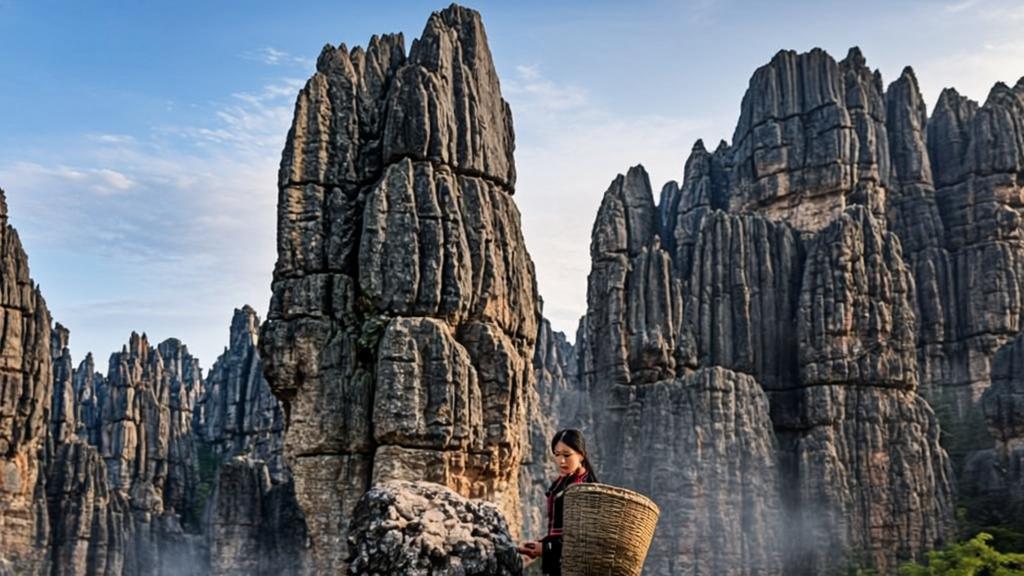
Yunnan Stone Forest doesn’t look like a love story. It looks like a battlefield — sharp limestone pillars erupting from the earth, some reaching over 40 meters tall, silent and unyielding. Yet locals have named nearly every formation. Some stones carry legends.
The most important one belongs to a girl named Ashima.
That layering — ancient geology wrapped inside ancient myth — is what sets this place apart from almost every other natural wonder on Earth. Most UNESCO sites offer one reason to visit. This one offers two, wound around each other so tightly they’re almost impossible to separate.
First, What Makes Yunnan Stone Forest So Unusual?
Shilin (石林) sits about 78 kilometers southeast of Kunming, in Shilin Yi Autonomous County. The protected reserve covers 350 square kilometers. The broader formation spans over 1,100 square kilometers in total.
Formation began roughly 270 million years ago. At that point, this area was a warm, shallow sea. Thick limestone layers accumulated on the seafloor. Eventually, tectonic shifts pushed the seabed upward. Rainwater, wind, and groundwater spent millions of years dissolving and carving the exposed limestone — separating pillars, deepening corridors, cutting caves into the rock.
In 2007, UNESCO listed two sections of the site as part of the South China Karst World Heritage property. The organization specifically recognized Shilin as the world reference site for pinnacle karst (UNESCO, 2007). That distinction is rare. It means no other stone forest on Earth exemplifies this geological type more completely.
And yet — that is only half the reason people come here.
Ashima and Yunnan Stone Forest: Where Geology Meets Legend
The Sani people are a branch of the Yi ethnic minority. They have lived in this region for generations. For them, the stone forest is not a geological specimen. It is a place where a girl’s defiance became permanent.
Her name was Ashima.
Most ancient cultures have a version of this story — grief or love so overwhelming that it reshapes the natural world. The Greeks had Niobe, who wept until she turned into a waterfall. The Norse had Freya, whose tears became gold when they hit the sea. The Sani had Ashima. She became stone.
That parallel is worth sitting with. Across cultures, humans have looked at striking natural formations and asked: what human story could explain this? The impulse is universal. The specific answer, however, belongs to one community.
The Story Behind Yunnan Stone Forest’s Most Famous Rock
Ashima was a Sani girl — skilled in song, strong in spirit, and in love with a shepherd named Ahei. Their happiness, though, attracted the wrong attention.
A wealthy chieftain’s son wanted Ashima for himself. When she refused, he had her kidnapped. Ahei fought back. He traveled long distances to find her. Then he competed against the chieftain’s men — in wrestling, in archery, and finally in singing. He won every contest. The chieftain had to release Ashima.
But revenge followed. The chieftain sent a flood. Ahei could not hold on. Ashima was swept away. Rather than surrender, she transformed into stone — and remained in the forest forever (Atlas Obscura, n.d.).
That stone stands in the Minor Stone Forest today. Visitors describe it as resembling a young woman in traditional Yi dress, carrying a basket on her back. It’s called the Ashima Stone. People still seek it out specifically. Some Yi couples even choose to marry nearby, honoring her story and asking for loyalty in return.
Ashima vs. Western Myths: Same Emotion, Different Message
Compare this to the myth of Orpheus and Eurydice. Both stories involve a hero crossing extraordinary danger to rescue a beloved. Both end in loss. In the Greek version, however, Eurydice is passive — she simply follows.
Ashima acts. She refuses her captor, repeatedly and clearly. The flood doesn’t conquer her — it completes her transformation on her own terms.
That distinction shifts everything. It turns a tragedy into something closer to a declaration. This is likely why the story has lasted so long. The epic poem Ashima has been translated into more than 20 languages, including English, French, German, Russian, and Japanese (Wikipedia, 2025). In 2006, China added it to its first National List of Intangible Cultural Heritage — a recognition of its enduring cultural weight.
The 1964 Film You Probably Didn’t Know About
In 1964, director Liu Qiong adapted the Ashima legend into a musical. It became China’s first full-color, widescreen musical with stereo sound (Hong Kong Film Archive, 2025). That alone was a significant milestone in Chinese cinema history.
Then, in 1982, the film won the Best Dance Film Award at the Santander International Music and Dance Festival in Spain (China Culture Tour, n.d.). A Sani folk legend from a mountain community in Yunnan, winning a European film award — not many people outside China know this happened.
In 2025, a 4K-restored version premiered at the San Sebastián International Film Festival. Remarkably, the legend keeps finding new audiences, more than sixty years after the original release (South China Morning Post, 2025).
Walking Through Yunnan Stone Forest: What to Actually Expect
First-time visitors often feel slightly disoriented. The columns press in from every direction. Pathways curve unexpectedly. Without a map, it’s easy to get turned around. Local guides joke that even birds lose their way here.
Most visitors enter through the Greater Stone Forest. This is the densest section — the tallest pillars, the most dramatic formations, the spots like Sword Peak Pond that appear most frequently in photographs. It is impressive. It is also, by midday, crowded.
The character changes significantly in the Minor Stone Forest. Formations are sparser here. The atmosphere is quieter. This is where the Ashima Stone stands. Standing in front of it takes a moment longer than expected.
Beyond the two main sections, the broader scenic area includes:
- Naigu Stone Forest (8 km north): Darker, rougher formations on older limestone. UNESCO specifically includes this section in the World Heritage designation. Far fewer visitors reach it, which means a noticeably different atmosphere.
- Karst caves: Several cave systems run beneath the stone forest. Zhiyun Cave and Qifeng Cave are both accessible and impressive underground.
- Long Lake and Moon Lake: Tranquil water that reflects the surrounding stone columns. Extraordinary in clear light. Worth the walk.
The stones change color throughout the day. Morning light turns them blue-gray. Afternoon light brings out warmth. Crowds consistently peak between 10 a.m. and 2 p.m.
How to Plan Your Visit to Yunnan Stone Forest
Getting there:High-speed trains from Kunming South Station reach Shilin County in approximately 35 to 40 minutes. Buses from Kunming’s East Bus Station take around 1.5 hours by road. Both options are straightforward and inexpensive.
Best time to go:
- Spring (March–May): Mild temperatures, occasional wildflowers scattered among the stone columns.
- Autumn (September–November): Clear skies, comfortable weather, lower visitor numbers overall.
- Summer (July–August): Hotter and busier. However, the annual Torch Festival — typically in late July or early August — transforms the landscape after dark. Bonfires, traditional Yi dances, wrestling competitions, and live music performed among the stone columns. It is genuinely unlike anything else in the region.
How long to stay:Three to five hours covers the main scenic area at a comfortable pace. A full day allows for Naigu Stone Forest and more breathing room. Staying overnight in Shilin County makes it possible to arrive at sunrise — a completely different experience from the midday version, and considerably quieter.
One practical note: Weekday mornings are the quietest window. The mist settles between the columns. The crowds haven’t yet arrived. The stones feel older, somehow — and in that silence, Ashima’s story becomes much easier to believe.
Some visitors come to Yunnan Stone Forest purely for the geology. That is reasonable. The geology alone is extraordinary — a UNESCO World Heritage site, the global reference standard for an entire category of karst landscape, 270 million years in the making.
But geology doesn’t explain why a stone pillar in the Minor Forest draws people who linger in front of it for a few minutes longer than they planned.
Ashima explains that.
Two hundred and seventy million years of geological history made this place. One girl’s refusal made it matter.
Both are worth your time.
References
Atlas Obscura. (n.d.). Shilin Stone Forest. https://www.atlasobscura.com/places/shilin-stone-forest
China Culture Tour. (n.d.). Ashima legend, Ashima love story Yunnan, Ashima culture. https://www.chinaculturetour.com/yunnan/culture/ashima-legend.htm
Hong Kong Film Archive. (2025). Ashima (4K restored version). https://www.filmarchive.gov.hk/en/web/hkfa/2025/sh/pe-event-2025-sh-fs-film01.html
South China Morning Post. (2025, October 4). Why was Ashima, pioneering Chinese musical film, shelved for years before its release? https://www.scmp.com/lifestyle/entertainment/article/3327589/why-was-ashima-pioneering-chinese-musical-film-shelved-years-its-release
UNESCO World Heritage Centre. (2007). South China Karst. https://whc.unesco.org/en/list/1248/
Wikipedia. (2025). Ashma. https://en.wikipedia.org/wiki/Ashma