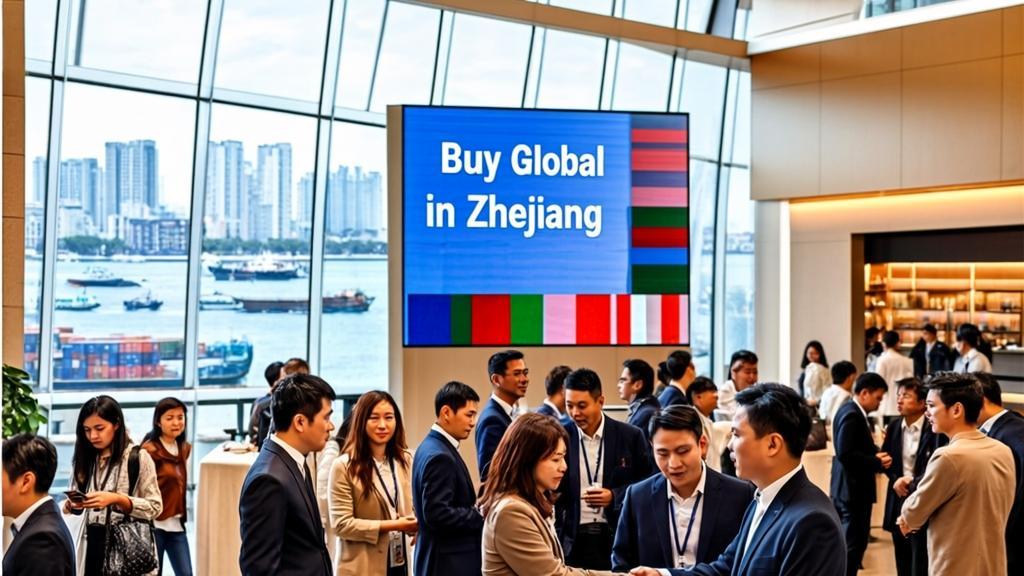
Zhejiang world market — that phrase carries real weight now. On March 15–17, 2026, Hangzhou hosted the “Buy Global in Zhejiang” event. It was the first leg of China’s national “Export to China” campaign held outside Beijing. The message was unmistakable. Zhejiang isn’t just making things for the world anymore. Instead, it’s inviting the world to come sell here.
From Workshop to Showroom: Zhejiang’s Trade Pivot
For decades, Zhejiang powered global supply chains as a manufacturing base. Now, however, the province is playing a different role entirely. According to Yicai, Zhejiang’s total goods imports reached 1.36 trillion yuan in 2025 — representing 7.4% of China’s national total (Miao, 2026). Hangzhou alone contributed 7.64% of national service trade imports. That’s a striking concentration.
Meanwhile, Zhejiang residents hold the highest per capita disposable income among all Chinese provinces. It exceeded 70,000 yuan in 2025. Consumer purchasing power here is substantial. And it keeps growing.
Zeng Gang, Dean of the Urban Development Research Institute at East China Normal University, put it directly. “Zhejiang has changed its previously low-key style,” he told Yicai. “It is now taking on greater responsibility at the national strategic level” (as cited in Miao, 2026).
The Infrastructure Behind the Zhejiang World Market
The Zhejiang world market story doesn’t run on ambition alone. It runs on infrastructure. Ningbo-Zhoushan Port stands as one of the world’s busiest logistics hubs. Zhejiang also launched China’s very first cross-border e-commerce pilot zone. Additionally, Alibaba — the global e-commerce giant — calls Hangzhou home. Furthermore, the province operates multiple national import trade innovation demonstration zones. Together, these assets form a high-efficiency system for global goods to enter China. Few other provinces can match that combination.
According to Global Times, Zhejiang’s total trade value reached 5.55 trillion yuan in 2025, up 5.4% year-on-year. The province conducted trade with more than 240 countries and regions (Global Times, 2026). That’s a broad footprint — and a notably stable one. Zhejiang has now posted year-on-year growth in both imports and exports for ten consecutive years since 2016.
“Export to China”: Rethinking the Trade Relationship
China’s Ministry of Commerce crafted the “Export to China” brand campaign with a specific purpose — to reshape how trading partners think about the Chinese market. Deputy Director Xiao Lu of the Ministry’s Foreign Trade Department explained the logic clearly at the Hangzhou event. The campaign deliberately takes the perspective of trade partners, not China itself. “This is a unilateral, self-initiated trade measure to expand opening up,” she said (as cited in Miao, 2026).
The name choice is deliberate. It says: come sell here. China is ready to buy.
Official data backs that claim. In 2025, China’s total goods imports reached a record high of 18.48 trillion yuan — approximately \$2.64 trillion. China has now ranked as the world’s second-largest import market for 17 consecutive years (People’s Daily Online, 2026). Moreover, China serves as the primary export destination for nearly 80 countries and regions. For foreign businesses, that’s a market too significant to overlook.
BRICS Cooperation and the Zhejiang World Market
The Zhejiang world market is also positioning itself at the center of multilateral cooperation. In February 2025, China’s Ministry of Commerce approved the establishment of the BRICS Special Economic Zone China Cooperation Center in Hangzhou. That’s a concrete institutional move — not just a policy headline.
The March 2026 Hangzhou event reflected this ambition directly. Organizers set up a dedicated BRICS import zone featuring goods from member countries across more than 600 product categories. Visitors could purchase products from South Africa, Brazil, Russia, India, and beyond. The goal was straightforward: deepen trade ties while building cultural exchange. For businesses from BRICS nations, Zhejiang now offers a structured, government-backed entry point into China’s consumer market (Miao, 2026).
What Foreign Businesses Should Know
The evolving Zhejiang world market creates tangible opportunities for international companies. However, understanding the framework matters first.
Access is improving. Zhejiang Governor Wang Hao publicly committed to better logistics, an expanded role for Hangzhou as an international consumption center, and a stronger environment for foreign enterprises. He also pledged to make it easier for quality goods and services to enter the market smoothly (Miao, 2026).
Domestic demand is real. China’s total retail sales of consumer goods exceeded 50 trillion yuan in 2025 — up 3.7% year-on-year. That’s not a theoretical figure. It’s an active, growing market.
Furthermore, investment and trade are converging. China’s Ministry of Commerce now pairs “Export to China” with its “Invest in China” campaign. The reasoning is practical. Foreign-invested firms that produce in China also import raw materials and components. In the first three quarters of 2025, foreign-invested enterprises accounted for 32% of China’s total imports. That link between foreign investment and import demand is significant. And it runs through provinces like Zhejiang.
Deeper Cooperation, Not Just More Trade
China’s broader goal isn’t simply to increase import volumes. Zeng Gang captured the nuance well. “China’s next phase of trade development isn’t about one-sided advantage,” he explained. “We’re looking for more balanced forms of cooperation — with regional and global partners” (as cited in Miao, 2026).
That includes importing raw materials and advanced technology. But it also means converting simple trade ties into deeper innovation partnerships. China’s 15th Five-Year Plan explicitly targets this direction — guiding foreign investment toward advanced manufacturing, high-tech sectors, modern services, and green industries.
Zhejiang, therefore, isn’t just a market. It’s a laboratory for China’s next stage of economic opening. The province combines digital infrastructure, global logistics, and strong consumer demand in one geography. That’s a rare combination. And it’s one the Chinese government is clearly betting on.
A Market That Means Business
The transformation of Zhejiang from export engine to global consumer hub reflects a real shift in China’s economic model. The province has moved beyond its low-cost manufacturing origins. Today, it positions itself as a gateway — for goods, for services, and for investment.
For foreign businesses watching China, the Zhejiang world market moment deserves close attention. Access points are expanding. Purchasing power is strong. Institutional support — through BRICS structures, free trade zones, and national-level campaigns — is growing. The policy direction, at least for now, points clearly toward openness.
References
Global Times. (2026, January 14). Multiple major foreign trade provinces in China register positive growth in 2025. https://www.globaltimes.cn/page/202601/1353637.shtml
Miao, Q. (2026, March 16). “世界市场”客厅浙江,何以打造外贸转型样板 [Zhejiang, the living room of the world market: How to build a model for foreign trade transformation]. Yicai. https://www.yicai.com/news/103088296.html
People’s Daily Online. (2026, January 17). China’s super-large market creates global opportunities with record imports. https://en.people.cn/n3/2026/0117/c90000-20415533.html